
5. Distribution: A managed fund does not mean automatic fundraising
“Establishing a fund with a reputable investment company helps build reputation, but does not by itself ensure an inflow of investors”
Key points
- The investment company (fund manager / fund administrator) manages and administers the fund – this is its core function
- Distribution / fundraising is an added value service (it is not automatically provided)
- Most investment companies do not distribute the funds they manage (only a few large investment companies do so, and only after meeting certain conditions – typically at least 1 year under management + alignment with their distribution strategy)
- Real estate funds in particular are difficult to place into distribution (there are many of them / they often have similar investment focuses)
- Fundraising remains primarily the responsibility of the founder
- Investment companies always require “skin-in-the-game”, i.e. a sufficient amount of the founder’s own assets at the outset to ensure the fund is viable (even without additional investors)
If the founder’s primary objective is to raise capital from investors, they need their own distribution capacity / an agreement with investment intermediaries / a way to make the investment company interested through “something special”
If the founder’s objective is to optimise their business with their own assets and gradually bring in investors, establishing a fund definitely makes sense.
Taxes in practice / fund, investor, VAT, founder remuneration
“The tax advantage of a fund is not ‘I do not pay taxes’, but rather ‘I defer and optimise them’. The fund reinvests almost all of its profit, and tax becomes relevant mainly when distributions are made to investors.”
Key points
Funds involve four tax levels:
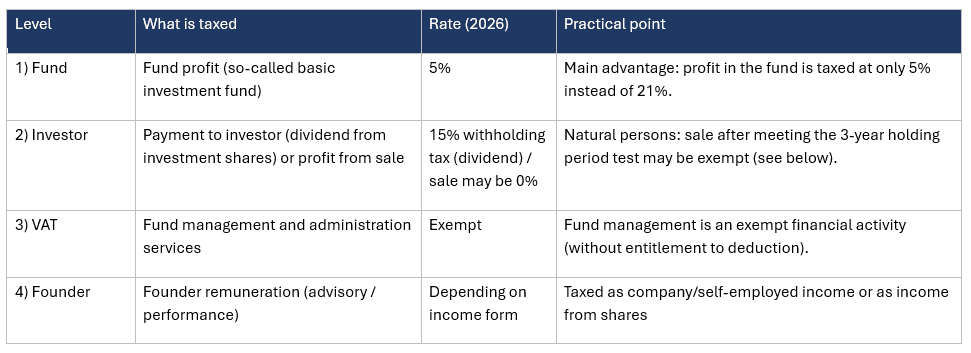
Level 1 — Fund taxation: 5%, but subject to conditions
- The basic 5 % tax rate applies to so-called basic investment funds (§ 21 and § 17b of the Income Taxes Act). For comparison: an ordinary company pays 21 %.
- The rate is not automatic. The fund must meet the conditions of § 17b of the Income Taxes Act – i.e. hold financial assets (shares, equities, financial instruments, receivables, etc.). In simplified terms, the fund must be a genuine investment fund (pooling and investing capital), not a disguised operating/development company.
- Reinvestment: due to the 5% tax rate, more capital remains in the fund after taxation for further reinvestment.
Level 2 — Investor taxation
- Individual — sale of investment shares/units: after meeting the 3-year holding period test, income from the sale may be exempt
- Corporate investor: income is included in its tax base according to general rules (possible exemption for qualifying shareholdings > 10% — must be assessed individually).
- Profit distribution (dividend from investment shares) → generally subject to 15% withholding tax.
Level 3 — VAT
- Fund management and administration = exempt financial activity (without entitlement to input VAT deduction). Therefore, the fund does not pay VAT on these key services.
- Attention to other services (legal, advisory, marketing) — these are generally subject to VAT.
Level 4 — Founder remuneration
- Depends on the form: advisory fee paid to the founder’s company (21% corporate income tax) vs. performance fee through a performance share class (income/dividend taxation regime)