
4. Who manages the fund / externally managed vs. self-managed
“You do not need your own licence from the Czech National Bank (CNB) to have a fund. In most cases, you ‘rent’ a fund manager and focus on what you do best — selecting and managing investments.”
Key points
Two models determining who holds the licence and bears management responsibility:
Model A: Externally managed (not self-managed) fund — recommended approach
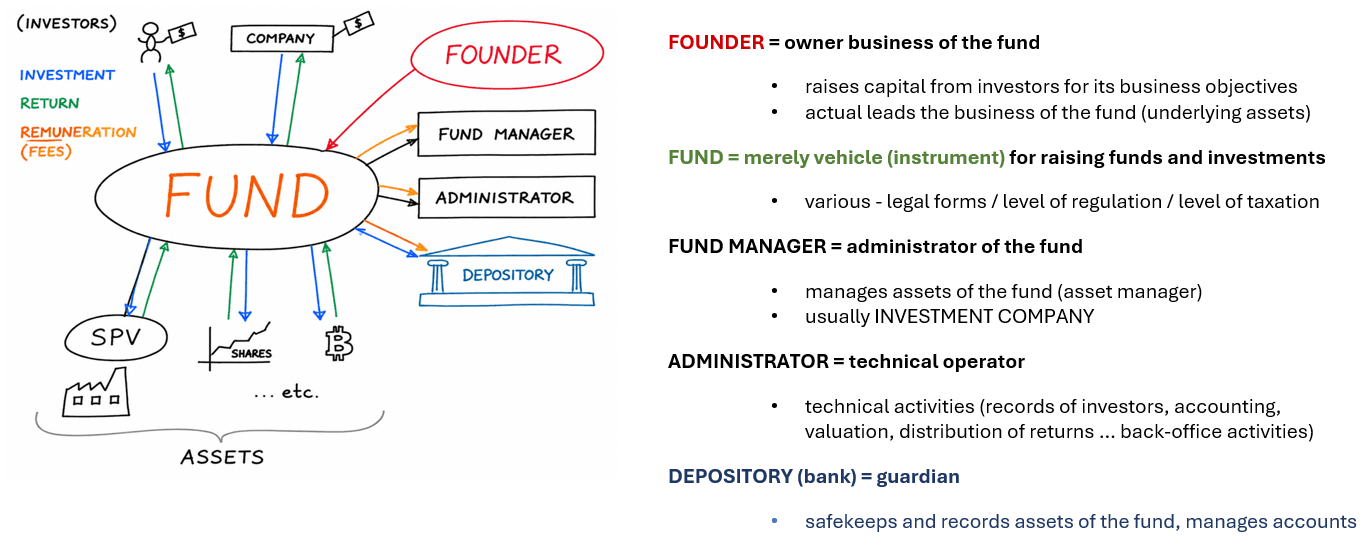
Advantages of the externally managed model:
- You do not need your own CNB licence → lower entry barriers and faster launch.
- The fund only needs to be registered in the CNB register (no licensing procedure, quick — approx. 1 month).
- Compliance, regulatory matters and reporting are handled by the fund manager — the founder focuses on investments and fundraising.
- Cheaper and faster than building your own licensed entity.
Model B: Self-managed fund — for advanced / larger structures
A self-managed fund holds its own CNB authorisation to manage the fund. It manages itself (or outsources part of the management).
- Requires a full CNB licence — high capital requirements (in the range of hundreds of thousands of EUR), professional infrastructure and experienced personnel, a governance and control system, and the licence process takes 1–2 years.
- Makes sense for large volumes and established teams that want full control and wish to save on management fees in the long term.
- Usually premature for a new founder — the costs and requirements outweigh the benefits.
- An externally managed fund can be converted into a self-managed fund once it reaches sufficient scale; fund managers generally do not object.
How does the founder actually manage investments when someone else manages the fund?
The founder’s most common concern (“Will I lose control?”). The investment company (fund manager) is the statutory body of the fund by law — the founder cannot act on behalf of the fund.
Influence is ensured contractually and structurally:
- Investment committee / advisory committee: the founder proposes and recommends specific investments; the fund manager makes the formal decision but practically follows the mandate set out in the fund statute.
- Investment strategy in the fund statute: you define the boundaries (permitted investments, regions, limits) — the fund manager operates within them.
- Investment advisory agreement: the founder (or their company) acts as the fund’s adviser and receives remuneration for this service.
- Founder has representatives on the statutory bodies of the underlying SPVs: direct influence on their business.
- Delegation of portfolio management: the fund manager may (subject to meeting the requirements) delegate part of the management to the founder’s team.
- Founder shares: voting control over the fund’s direction remains with the founder.
Attention — limits of control: The fund manager bears regulatory responsibility and therefore always has the final say (especially regarding risk management and compliance). The founder can never obtain “full control” over an externally managed fund. Independent oversight = investor trust.